

For a Colorado teacher, a home purchase is both a housing decision and a calendar decision. Your contract, paycheck schedule, school location, and available cash deserve as much attention as the listing photos. This guide explains how to build a practical plan, compare a real Colorado public-school employee program with our separate brokerage rebate, and keep the closing benefit from overshadowing the monthly cost of ownership.
Start with the school year, not a presumed buying season
There is no requirement to buy during summer break. Start by identifying when you can realistically tour, review documents, attend inspections, and move. Put professional development, classroom preparation, family commitments, and any change of employer on the same planning calendar. A convenient moving week is useful, but it should not force you into a property or financing arrangement you do not understand.
Create two lists: the dates you control and the dates someone else must confirm. You might control when to schedule tours, but a seller must agree to possession terms and a lender must complete its review. A school start date does not guarantee closing or delivery of keys. Keep a backup for the interval between your desired arrival and confirmed access to a home.
If your job assignment is changing, note the campus or work location that is confirmed rather than assuming it will remain the same. Test the route relevant to your actual schedule when practical. A lower-priced home farther away may involve a tradeoff you welcome, or one you would find difficult during the school year. Compare the routine honestly instead of making a decision from a map radius alone.
Explain your contract and paycheck pattern early
Prepare the documents your lender requests, which may include employment agreements, pay records, and information about the start of a new position. Ask how the lender will evaluate your income and which conditions remain outstanding. Your household's monthly cash flow and the income used for mortgage qualification are related but different calculations. Do not decide that a particular contract automatically guarantees approval.
Fannie Mae's employment-offer and contract guidance describes conditions for loans using future employment income. That is a useful discussion resource if you are starting a Colorado position, not a promise that every lender or loan product will accept your situation. Ask the lender to identify the applicable requirements and any funds needed before the first paycheck arrives.
For your own budget, write down when money actually arrives. If an employer offers a choice of pay distribution, confirm your selection with payroll. Distinguish contracted base pay from coaching, tutoring, summer work, or other supplemental earnings. Ask the lender how each source is evaluated, and build a personal housing budget that does not depend on optional work you would rather not need.
A hypothetical paycheck-smoothing example
Imagine a fictional teacher with an annual gross salary of $60,000. If that amount is distributed in ten equal payments, each payment would be $6,000 gross; spread over twelve months, the annual average is $5,000 gross. Those are arithmetic illustrations, not typical Colorado salaries, take-home pay, or lender calculations. Taxes, deductions, benefits, and an employer's actual payment schedule still need to be considered.
Suppose this household chooses a $2,000 monthly housing target. Reserving two months of that housing amount would require $4,000. The purpose is not to recommend that reserve for every teacher. It is to reveal a planning question: which bills continue during any period without a paycheck, and what money will cover them? Add other living costs before deciding whether the purchase fits.
Next, separate that operating reserve from transaction funds. Earnest money, inspections, moving expenses, the remaining cash to close, and the emergency cushion should not all draw from the same dollars on paper. Ask the closing professional how deposits already paid are reflected in the final calculation. A budgeting worksheet becomes useful when each dollar has one job rather than several competing promises.
How this site's teacher buyer rebate works
Teachers are one of the service categories offered on this site's buyer inquiry form. Confirm your eligibility and the applicable documentation with the Flat Rate Realty Team. The brokerage offer starts with 50% of the buyer-agent commission the brokerage receives, subject to the brokerage retaining at least $6,500. A smaller commission can reduce the illustrated rebate below half. It is not 50% of the home's price.
For example, $14,000 in received commission illustrates $7,000 for the buyer and $7,000 retained by the brokerage. With $11,000 received, the illustrated rebate is $4,500 so the brokerage retains $6,500. These are hypothetical commission amounts, not assumed commission rates or a promise of seller-paid compensation. The actual agreement, lender approval, and closing requirements determine the permitted benefit.
If received commission is below $6,500, the illustration produces no rebate and a shortfall to discuss. The arithmetic does not establish who owes that difference. Our team requires lender preapproval and a signed buyer agreement before showings. Review the services, compensation obligation, eligibility, and rebate terms before touring, then use the detailed rebate examples to ask property-specific questions.
A separate Colorado resource: CHFA Schools To Home
CHFA Schools To Home is a separate financing program for eligible full-time Colorado public-school employees. CHFA describes a first mortgage with down payment and/or closing-cost assistance through a second mortgage and a shared-appreciation obligation. It is not our brokerage rebate, and the assistance should not be described as automatically free money.
CHFA's published eligibility definition includes specified public-school employers and requires lender documentation of eligible full-time employment. The program also requires education, including its financial-commitment course and CHFA-approved homebuyer education. Ask a participating lender to confirm your employer, eligibility, current availability, loan terms, repayment events, and the shared-appreciation calculation. Private-school employment or a job title alone should not be assumed to satisfy this particular program.
Keep this research distinct from the brokerage conversation. Ask whether your proposed loan, any assistance, seller contributions, and the brokerage rebate can be combined, and how each would be documented. Do not assume that qualifying for one benefit establishes qualification for another. A clear comparison should explain both the cash needed now and the obligations you may have when selling, refinancing, or changing how you occupy the home.
| Item | What to investigate |
|---|---|
| Brokerage teacher rebate | Eligibility, commission received, $6,500 minimum retained, written terms, permitted application. |
| CHFA Schools To Home | Eligible employment, participating lender, second-mortgage repayment, shared appreciation, education. |
| Seller contribution | Negotiated contract amount and the lender's treatment of the combined credits. |
| Your cash reserve | Funds you control for paycheck timing, repairs, moving, and unexpected expenses. |
Have the lender review the combination, not the headline
A brokerage credit, a seller contribution, and a lender credit are not interchangeable labels. Give the lender the proposed written terms early and ask what amount can be used for which expenses. Request an updated estimate if the price, compensation, loan product, or other credits change. Do not rely on a projected rebate to fund a deposit due before closing.
For loans subject to Fannie Mae's interested-party contribution rules, agents and brokers are among the interested parties, and permitted uses and limits matter. That source explains why a rebate needs transaction-specific review rather than a side arrangement. Ask your lender to apply the correct rules for your loan; do not assume the treatment is identical across financing programs.
Use the lender's written explanation to update your cash worksheet. If a projected benefit cannot be applied as expected, ask the team and lender what permitted options remain before you make a commitment that depends on it. No one should promise unrestricted cash after closing simply because a commission calculation produces an attractive amount.
Choose a home for the life around your teaching work
Compare individual addresses, not just a city label. In Colorado Springs or Denver, your practical search area may be driven by the workplace you actually need to reach, household transportation, and the property budget. This is not a claim that a particular neighborhood is best for teachers. Your priorities should determine the comparison.
Look at the space you will use after work. You might need a quiet area for planning, reliable connectivity to verify, or storage that keeps school materials separate from living space. If an exact room size or internet service is essential, confirm it rather than inferring it from staging photographs. Also consider whether outdoor maintenance, snow removal arrangements, or an HOA's responsibilities fit the time you want to spend on upkeep.
If children in your household will attend school, verify attendance boundaries, enrollment, and program requirements directly with the responsible district. Your workplace and a home's assigned school are different questions. Avoid assuming that employment with a district or a listing's school label guarantees a particular enrollment outcome. Make those confirmations before treating an address as a final fit.
Protect the budget after the keys arrive
Get an address-specific insurance quote and review taxes, HOA obligations where applicable, utilities, and maintenance. Separate required loan costs from the personal reserve you want afterward. An inspection concern deserves its own evaluation even when the home is otherwise convenient for work. Request appropriate professional estimates for material repairs instead of counting a projected rebate as a universal repair fund.
Compare a manageable monthly payment with a manageable first year. Moving supplies, small repairs, service setup, and furnishing decisions can accumulate. Write a short first-year plan with immediate needs, work that can wait, and optional improvements. A modest project list gives you room to settle into the home without turning the first school term there into a series of rushed spending decisions.
Try a no-extra-work budget as a personal stress test. Would the house still fit if you did not take an optional summer assignment or additional duty? This does not tell the lender how to underwrite your income. It helps you decide how much flexibility you want in your own life. If the answer is uncomfortable, revisit the price range and recurring expenses before relying on a closing credit.
Think about the next move before the first closing
Ask what happens if your plans change sooner than expected. You may accept another position, need different space, or decide that a shorter commute matters more than it did at purchase. Compare the obligations attached to each proposed financing option. A lower cash requirement today and a repayment or shared-appreciation obligation later should be understood together rather than discussed in separate sales conversations.
Create a simple question sheet for the lender: what balance would remain after a chosen period, what events trigger repayment of assistance, what fees or restrictions need review, and what assumptions are being used? You do not need to predict a future sale price to ask these questions. Avoid treating appreciation as certain or using it as the only way the plan will work.
Keep your own priorities visible during that comparison. If flexibility is especially important because your work assignment may change, explain that. If you expect to stay but want to reduce your initial cash contribution, explain that too. The purpose is not to select a product from a generic teacher label; it is to understand a proposal that fits your household's actual needs.
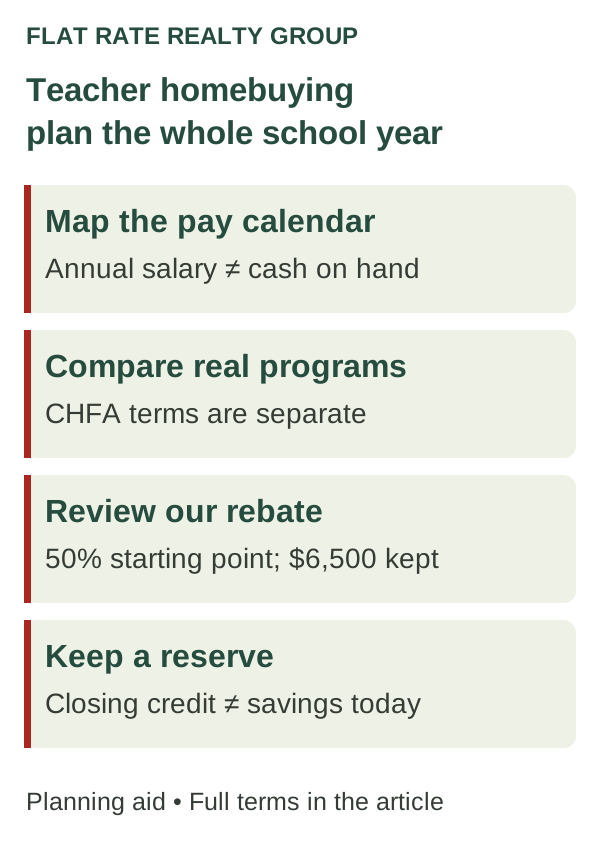
Your teacher homebuying checklist
- Confirm the work location, contract dates, and actual paycheck schedule with your employer.
- Ask the lender which income and employment documents are required for your proposed loan.
- Set a monthly housing budget and a separate reserve for any paycheck gap.
- Obtain preapproval and review the buyer agreement before showings.
- Confirm teacher-category eligibility and the brokerage rebate terms in writing.
- If relevant, ask a CHFA participating lender about Schools To Home without assuming eligibility or free assistance.
- Compare addresses, property condition, insurance, and ongoing costs on the same worksheet.
- Have the lender and closing professional reconcile every credit and the final cash requirement.
Questions Colorado teachers often need answered
Does being a teacher guarantee a mortgage or grant?
No. Employment, loan qualification, and eligibility for a particular program are separate matters. Ask the responsible lender or program administrator to evaluate your situation. Our brokerage offer is not a government grant, and selecting a service category on an inquiry is not an approval.
Can I use the rebate as my down payment?
Do not assume that. The benefit depends on the agreed compensation, brokerage minimum, and lender and closing requirements. Ask what expenses can be covered and what funds you must provide yourself. Keep early expenses and required reserves separate until the lender confirms the actual structure.
Is Schools To Home the same as the teacher rebate?
No. CHFA's program has its own eligible-employment definition, financing terms, education requirements, and repayment obligations. Our rebate is a brokerage compensation arrangement. Ask about any proposed combination rather than treating the programs as one package or assuming both will be available.
Must I move during a school break?
No particular moving season is required by our service. Plan around your work and household needs, the contract, and confirmed possession. If your preferred dates are tight, discuss a backup rather than assuming a purchase will close simply because the school calendar makes that week convenient.
Start with a calendar and a sustainable budget
Share your intended Colorado area, comfortable payment range, preapproval status, and moving window. Let the team know that you are asking about the teacher buyer offer and bring any program questions to the appropriate lender. Use the existing buyer inquiry form to select your service category; do not send pay records or sensitive identifiers in an initial message.
A useful plan should leave you knowing which dates matter, which income is documented, which benefits are actually available, and how much cash remains after the purchase. The goal is a home that supports your everyday life throughout the year, with a rebate that is clearly understood rather than a headline that substitutes for the rest of the decision.
Sources and practical resources
Primary sources checked October 20, 2026. Confirm current program availability and your transaction with the responsible lender, program administrator, or professional.
- Fannie Mae's employment-offer and contract guidance
- CHFA Schools To Home
- Fannie Mae's interested-party contribution rules
General education, not individual financial, legal, or tax advice or loan approval. Eligibility, services, fees, and rebates depend on written terms and applicable lender and closing requirements. Flat Rate Realty Group is independent of VA, the military, CHFA, HUD, employers, and public agencies; links do not imply affiliation or endorsement.