
Colorado Teachers: A Condo Buying Checklist
By Flat Rate Realty Group · Published October 25, 2026 · Prepared with AI assistance.

A Colorado teacher considering a condo should compare the unit, the association, the financing, and the daily routine together. A lower purchase price can be attractive, but dues, insurance, assessments, building conditions, and project eligibility can change the decision. Gather the documents early and build a housing budget that works during the school year and beyond.
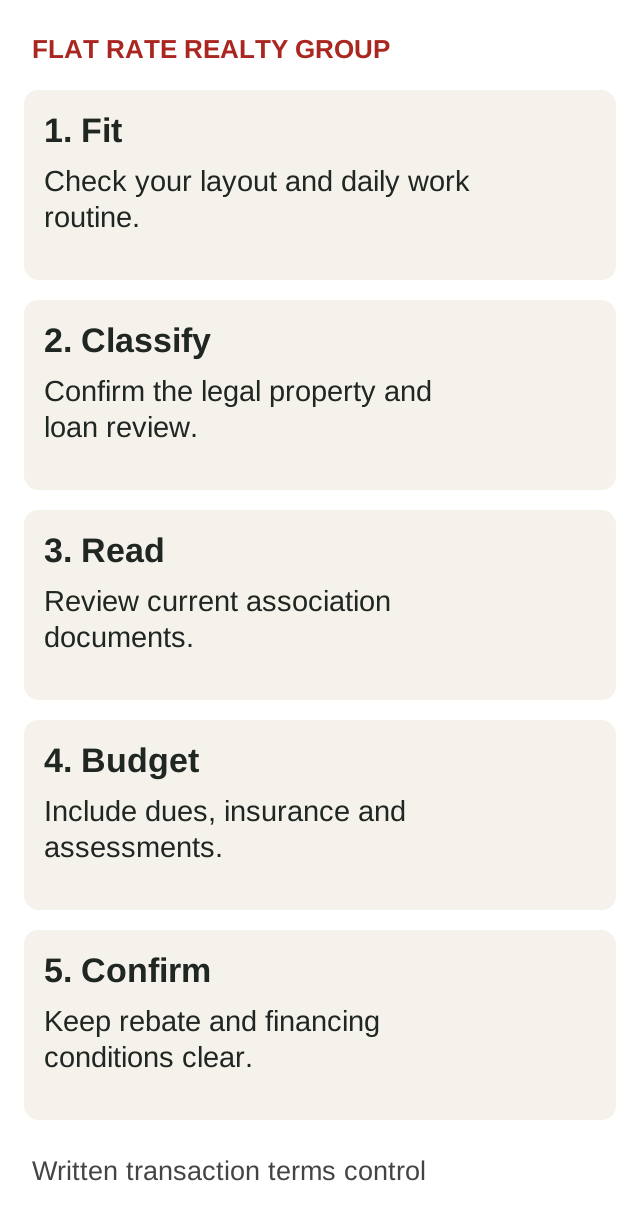
Begin with the kind of home your workday needs
For a teacher, a condo may offer a useful layout or location without the same yard responsibilities as a detached property. That possibility is worth investigating, but it is not a promise that association living is maintenance-free. Identify the actual tasks the association handles, the work that remains yours, and whether the building's rules support the way you plan to live.
Start with your own priorities: a quiet place to prepare lessons, storage for materials, parking when returning after an evening event, reliable internet options, and a route to the actual workplace. These are examples to adapt, not assumptions about every teacher. A household with a second workplace, accessibility needs, or regular visitors may organize the comparison differently.
Write the priorities before touring. Separate essential features from preferences, and note what requires verification. Photos can suggest where a desk might fit, but they do not establish sound separation, internet service, or permission to use a space in a particular way. Ask focused questions so the tour leads to evidence rather than a general impression that the condo seems convenient.
Confirm what the property legally is
A building's appearance is not a reliable classification. A home described casually as a townhouse may involve a condominium form of ownership or a different legal structure. Ask the broker and lender to confirm how the property is classified from the relevant documents. That answer can affect the review, insurance discussion, and financing path.
Fannie Mae's current project-standards guidance distinguishes project eligibility from the individual borrower's credit review. For a loan using its requirements, the lender evaluates the applicable project standards in addition to the buyer, transaction, and individual unit. Ask which program and review method apply rather than assuming that personal preapproval means the project is approved.
This article does not certify a building's eligibility or supply a universal approval checklist for every mortgage. Conventional, FHA, VA, portfolio, and assistance-related transactions can require different analyses. Give the lender the actual address early and ask what project information it needs before you rely on a particular loan structure.
Read the dues number as the start of a budget
The CFPB explains that association dues are usually paid separately from the mortgage-servicer payment. Confirm how your proposed loan estimate treats them. A payment quoted with taxes and insurance may still exclude the association, utilities, parking charges, or other property-specific expenses.
Ask what the dues cover and obtain the answer from current documents. One association may handle certain exterior components or utilities while another allocates them differently. Do not subtract an insurance or maintenance expense merely because the association has a policy or a vendor. Identify what remains the owner's responsibility and ask the appropriate professional to explain unclear boundaries.
Compare dues with services and financial responsibilities, not just with another building's lower number. A smaller monthly charge does not itself prove efficiency, and a larger charge does not itself prove stronger reserves or better condition. The documents and actual obligations help explain what the number means for your household.
Organize the association review into useful questions
The Colorado Division of Real Estate's buyer resource points prospective purchasers toward association-document review. Ask your broker which documents and deadlines apply to the completed purchase contract and how to obtain the available materials. Keep the current package together rather than collecting disconnected screenshots from different years.
Build a document index with the title, date, source, and question it answers. Useful requests may include governing documents, current budget information, financial statements, available reserve information, insurance documents, meeting records, assessment notices, and information about pending work. Availability and the transaction's requirements must be confirmed; this list does not establish a freestanding entitlement to every record.
For each document, write a short practical question. A budget may prompt a question about a projected expense. Meeting records may identify a project requiring clarification. An insurance document may raise a question for your insurance professional. The objective is not to become an association accountant or attorney overnight. It is to identify the decision-relevant issues and direct them to qualified sources before the applicable deadline.
Distinguish operating expenses from future projects
Ask how the association plans for major work and what information supports that plan. A current operating budget and a reserve study answer different questions. If reserve materials are available, note their date, the components considered, and whether subsequent work or price changes may affect the assumptions. Ask management to explain how the plan relates to current funding.
A discussion of a possible roof project is not the same as an approved special assessment. Separate proposals, decisions, notices, contracts, and payment obligations. If an assessment exists, ask about the amount, payment schedule, what it funds, and the proposed allocation between seller and buyer under the transaction documents. Do not assume the seller pays everything because the issue was discussed before the purchase.
Avoid deciding from a single reserve percentage or a rule of thumb copied from a national article. Ask the lender what it needs for the actual project and ask appropriate professionals about the association's information. Missing records are a question to resolve, not evidence that the project has no issues or that every future expense will be covered.
Review the association and personal insurance together
Provide the available association insurance information to the lender and your insurance professional. Ask what coverage the unit owner needs, where the policies may overlap or leave gaps, and what deductibles or other responsibilities matter. A policy summary in a marketing packet is not a personalized coverage recommendation.
Before relying on a quote, verify the unit, building classification, intended occupancy, and any known conditions the insurer needs to assess. Ask when coverage can begin and which questions remain open. If the association policy changes during the transaction, tell the lender and insurance professional promptly rather than assuming the earlier answer remains valid.
Keep the premium separate from a repair reserve and any assessment allowance. Insurance is not a substitute for understanding maintenance responsibilities, and a maintenance budget is not proof that every unexpected event is affordable. The goal is a clear picture of how each risk is being addressed, with written answers where the purchase decision depends on them.
A hypothetical two-condo cost comparison
Imagine Condo A is priced at $340,000 and Condo B at $355,000. For illustration only, suppose the lender estimates a $2,150 payment including principal, interest, taxes, and the relevant property-insurance allowance for A, compared with $2,250 for B on the same stated basis. The prices and payments are invented, not market averages or financing offers.
Assume A has $425 monthly association dues and B has $280. Adding a hypothetical $100 monthly owner-maintenance allowance to each creates simplified totals of $2,675 for A and $2,630 for B, before utilities and other unlisted costs. Under these assumptions, the lower-priced unit has the higher monthly total by $45. Ask what the dues cover before concluding that B is the better value.
Now suppose B has a documented $6,000 assessment the buyer would be responsible for under the proposed agreement. If paid over an illustrative 24 months, the simple cash-flow equivalent is $250 monthly, bringing that scenario to $2,880 during that period. This division is a planning tool, not a statement that the association offers that installment option or the lender will underwrite it that way. Use the actual payment terms.
Also compare the cash left after closing. A household may be able to afford the same average monthly cost but find a lump-sum assessment harder to absorb during a move. Keep deposits, closing funds, immediate work, moving, and reserves visible. Do not spend a projected buyer rebate on paper before the amount and permitted use are confirmed.
Connect the purchase calendar with the school calendar
Tell the team which dates are fixed and which are preferences. A break may be a convenient time to move, but it does not guarantee contractor availability, document delivery, loan approval, or possession. Compare the closing and move-in dates in the actual agreement with your work commitments, and keep a fallback for a delay.
If a new teaching contract, a changed employer, or a different pay arrangement is part of the move, ask the lender what documentation it needs and when. This article does not determine qualifying income or promise that a future contract will be accepted. Use the broader Colorado teacher homebuying guide to prepare the financing conversation without mixing it with the association review.
During the tour, investigate the routines that matter on a teaching day. Visit the actual parking arrangement, consider how materials will be carried from the vehicle, and identify the space you would use for preparation or remote meetings. Check relevant building rules directly. A short mapped commute does not answer these daily-use questions or guarantee the travel time you will experience.
Apply the teacher buyer rebate only after the budget works
Flat Rate Realty Group's new-site buyer offer is 50% of commission actually received, reduced as needed so the brokerage retains at least $6,500. Lender preapproval and a signed buyer agreement are required before showings. Teacher eligibility, the written agreement, and lender and closing requirements apply. The offer is not a government education benefit or a promise that a condo project will qualify for financing.
For an invented $10,000 received commission, half would be $5,000, leaving the brokerage below its minimum. The preliminary rebate would be reduced to $3,500 before other applicable conditions. At $14,000 received, the preliminary 50% amount would be $7,000. These calculations do not assume a commission rate or establish a credit for a particular property.
Ask the lender and settlement agent whether the proposed credit is permitted, what eligible expenses it can offset, and how it interacts with other credits. Do not assume it can pay association dues indefinitely, satisfy reserves, or be handed over as unrestricted cash. The rebate examples and closing guide explain the separate calculation and documentation questions.
Follow one assessment question through the documents
Suppose a fictional buyer sees a meeting reference to exterior work, a budget allowance, and a seller statement that no assessment is currently due. Those statements may describe different stages of a project rather than a contradiction. Ask whether work is proposed or approved, whether a provider has been selected, how it would be funded, and whether any payment obligation has been established. Record the document date with each answer.
Next, ask the lender whether the unresolved issue affects project review and ask the broker how the contract addresses available association information. A buyer should not convert a budget allowance into a personal bill without further evidence, but should not ignore a planned project because the current monthly dues look affordable. This sequence turns a vague concern into defined follow-up tasks and keeps the decision tied to the actual building.
Think about ownership beyond the first school year
Consider what would happen if your workplace, household size, or expected stay changes. Review the building's documented rules on renting, occupancy, pets, parking, and alterations to the extent relevant to your plans. Do not assume you can retain the condo as a rental later or modify a room simply because the current seller has used it that way. Ask qualified professionals about restrictions you do not understand.
Also ask how a future sale might be affected if association documents, insurance, or building conditions change. This does not predict that the unit will be harder to sell. It recognizes that project-level information can matter to a later buyer's financing as well as your own. Keep the documents from your purchase, understand how owners receive updates, and include the time needed to manage association responsibilities in your ownership plan.
A condo review checklist before committing
- Confirm the legal property classification and applicable financing review.
- Request the current association package and record the contract deadlines.
- Identify dues, services, insurance responsibilities, and separate charges.
- Clarify approved assessments, planned projects, and available reserve information.
- Obtain a property-specific personal insurance quote.
- Test monthly cash flow and the cash required immediately after closing.
- Check the layout, access, rules, and route against your actual workday.
- Review the rebate separately and resolve lender conditions early.
Questions to ask before choosing the unit
Does preapproval mean the condo is financeable?
Not by itself. Ask the lender which property and project reviews remain and what documents are missing. A buyer's credit approval does not replace those decisions. Keep financing status attached to the actual address and loan program rather than assuming an answer for another building applies here.
Should low dues be my main selection criterion?
No single dues figure explains the full ownership obligation. Compare covered services, unit-owner responsibilities, available financial information, assessments, insurance, condition, and the household's budget. A useful decision explains why the complete arrangement fits, rather than choosing only the smallest recurring charge.
What if the documents arrive late or raise concerns?
Tell your broker and lender promptly and have them explain the options under your actual contract. Do not assume a blog supplies an automatic extension or termination right. Record the unresolved questions, their potential effect on your decision, and who is responsible for obtaining an answer.
General planning information. Eligibility, written agreements, lender approval, and transaction requirements apply. No government affiliation or endorsement.