
Colorado Sellers: Inspection Repairs or Credits?
By Flat Rate Realty Group · Published October 25, 2026 · Prepared with AI assistance.

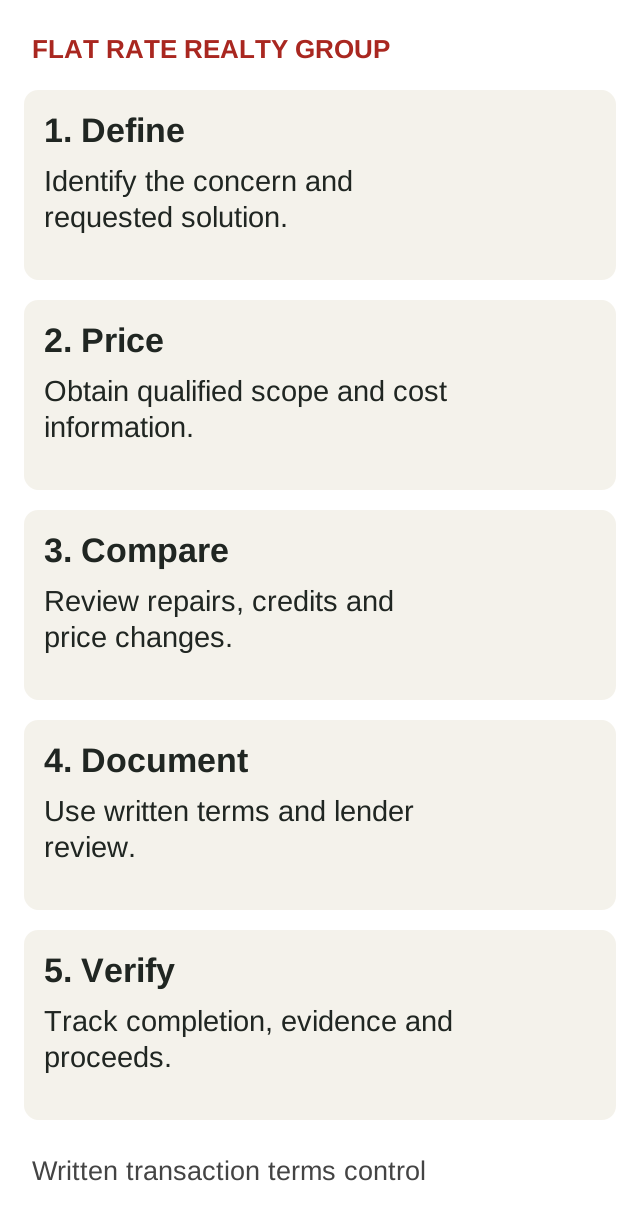
When an inspection raises a concern during a Colorado home sale, compare the proposed repair, a permitted closing credit, and any price adjustment as different solutions. Define the actual problem, obtain qualified information, involve the lender when needed, and put agreed terms into the appropriate written documents. The best choice must work for the property, the financing, and the calendar.
Separate the report from the requested agreement
An inspection report records observations and recommendations within the inspector's scope. A buyer's request proposes what the parties should do about selected issues. Those are different documents with different purposes. Begin by identifying the exact concern, the report reference, and the action requested. A long report does not tell the seller which proposed terms have been accepted.
Ask your broker to explain the inspection provisions and actual deadlines in the completed purchase contract. This guide supplies no standard response period or automatic termination rule. The relevant dates and rights come from the agreement and applicable requirements, not from the date someone informally forwarded a report. If a legal interpretation is needed, obtain appropriate legal advice.
The Colorado Division of Real Estate's current contracts and forms include inspection-related documents. Its Commission position statements include guidance on resolving inspection issues. Use the appropriate current documents with your professionals rather than adapting language from an unrelated sale.
Define the concern before pricing a response
“Fix the plumbing” is difficult to evaluate because it does not describe the component, observed condition, requested outcome, or necessary investigation. A more useful discussion identifies the report item and asks a qualified professional to assess it. The professional may need access, testing, or additional information before offering a meaningful scope and price.
Keep the original observation separate from a diagnosis. A stain does not by itself establish its cause, and an appliance's age does not by itself establish a failure. Avoid treating an early allowance as a confirmed repair cost. If different professionals propose different scopes, ask what each includes and excludes before comparing the amounts.
Organize the issue in a short decision record: condition described, evidence available, professional consulted, proposed solution, estimated cost, and unresolved questions. This is useful to both sides because it shows where disagreement lies. Sometimes the parties disagree about responsibility; sometimes they are simply pricing different work.
Option one: complete agreed work before closing
A repair can address a condition before the buyer takes possession, if the work and timing are feasible and the parties agree. Discuss the scope, qualified provider, access, permits when applicable, completion date, invoices, warranties if available, and how completion will be evaluated. Do not assume that a general promise to repair answers all of those questions.
Obtain a written proposal before committing to a broad obligation. Ask what could change the price, whether further investigation is required, and how unexpected findings will be handled. A contractor's earliest available appointment may not fit the proposed closing. Identify that conflict while the parties are considering terms, rather than promising completion and discovering the scheduling problem afterward.
Agree through the appropriate documents on what evidence is needed. A paid invoice, photographs, a report, or another inspection may answer different questions. The brokerage can help coordinate information, but it does not certify technical performance. If a specialist's sign-off matters to the agreement or financing, establish who obtains it and when.
Option two: negotiate a permitted closing credit
A credit can change the approved closing calculation without requiring the seller to manage the same work before closing. However, it does not physically repair the property. The buyer still needs to understand the condition, arrange any later work, and have the funds and ability to complete it. The lender must determine whether the proposal works for the actual loan and property.
Fannie Mae's interested-party contribution guidance explains that contributions are subject to defined uses and limits and cannot be used to satisfy the borrower's down payment or required reserves under those rules. That is one program's guidance, not a universal credit rule for every mortgage. Ask the buyer's lender to review the entire proposed structure.
Do not offer an undisclosed payment after closing to get around a lender limitation. Ask how any seller credit, lender credit, brokerage rebate, or assistance interacts in the actual file. The permitted amount may differ from the amount the buyer and seller initially prefer. Resolve the question openly before relying on the proposal.
Option three: consider a price adjustment
A lower price affects the purchase amount and may change financing calculations. It is not necessarily equivalent to the same dollar amount credited toward eligible closing costs. A buyer who needs cash for immediate work may experience the options differently. Have the lender explain the actual cash and payment effect of each structure.
For a simplified hypothetical example, a $5,000 price reduction with a loan-to-value assumption of 90% would reduce the illustrative loan amount by $4,500 and the down-payment component by $500. This is arithmetic, not an approval, appraisal result, or statement about a loan program's required down payment. Other costs and loan terms could change. It shows why a $5,000 price reduction need not put $5,000 more cash into the buyer's hands at closing.
Ask the closing professional and lender to compare both structures using the same underlying assumptions. Keep the actual negotiated price, credits, and agreed work separate. If several parts of a counterproposal change together, label the entire version rather than comparing one revised number against an older worksheet.
A hypothetical seller comparison
Imagine an accepted $450,000 sale with an inspection concern. A qualified provider supplies an invented $3,200 repair proposal, and the parties consider a $4,000 closing credit instead. Assume for this exercise that the credit is permitted, the work can occur after closing if that option is selected, and all other costs remain unchanged. These assumptions must be verified in a real transaction.
On direct cost alone, the credit is $800 more expensive to the seller. Now suppose completing the repair before closing would also require $600 in additional carrying and coordination expenses under the household's planning assumptions. The illustrated difference narrows to $200. Neither result determines which option to choose: scope certainty, scheduling, financing requirements, and the buyer's ability to complete later work still matter.
Next, suppose the provider identifies a possible additional $1,500 of work that cannot be priced conclusively without opening the affected area. The repair scenario now has a range rather than a single dependable figure. Ask the professional and broker how to handle the uncertainty before signing. Do not automatically add the full amount to every scenario or present a tentative concern as a confirmed defect.
Finally, compare what each option actually resolves. A credit negotiated for a specific concern may not include a separate issue raised later. A repair proposal may exclude cosmetic restoration or permit-related work. Clarify the scope instead of assuming that matching dollar figures create equivalent outcomes.
Keep inspection, appraisal, and underwriting questions distinct
A buyer and seller may agree on a solution while the lender still has a separate property or financing question. Ask the lender whether the proposed condition, repair, credit, or timing affects approval. Do not assume a credit makes every condition acceptable or that an inspection recommendation is automatically a lender-required repair.
The Colorado Commission's published inspection-resolution form notes that it amends the contract and that the buyer must provide it to the lender. Confirm the applicable current form and delivery process with your broker. Do not leave a material agreement outside the lender's review because the parties describe it as a small repair arrangement.
Provide documents early enough for questions to be answered. Ask which participant will send the signed agreement and who confirms receipt. If the proposal changes after review, send the updated version through the appropriate process. An informal conversation about what the lender might allow is not a substitute for transaction-specific approval.
Build a completion calendar that can be carried out
For agreed repairs, work backward from the required completion and verification dates. Include contractor availability, access, materials, any required permits or inspections, invoicing, and the time needed to address an incomplete result. A moving household may need a local contact to provide agreed access, but that person should not be assumed to have authority to change the deal.
For a credit or price adjustment, confirm the signing and disclosure steps with the lender and settlement professionals. The CFPB's Closing Disclosure explainer encourages buyers to compare final loan and closing details with prior expectations and ask about differences. The responsible professionals should explain the effect of any late change on this closing.
Keep a fallback for a missed milestone. Discuss the options under the actual contract if a contractor cannot finish, a required approval is delayed, or verification raises a new question. Do not assume the parties have agreed to extend closing simply because a provider has rescheduled.
Update the seller's complete proceeds estimate
Place the selected obligation on its own line in the proceeds worksheet and check whether it is already included elsewhere. If a credit replaces a repair, deducting both would distort the estimate. If a seller pays a contractor before closing, track that expense in the household budget even if it is not a new settlement deduction.
Our listing fee is $3,300 under $500,000 and 0.85% at or above $500,000; exactly $500,000 illustrates a $4,250 listing fee. Buyer-agent compensation is separate if agreed. The listing term is 120 days, with a $250 fee on cancellation or expiration and professional photography delivered then under the written terms. Professional photography and one open house are included; drone footage applies to select properties.
Those listing terms do not establish repair prices or absorb every contractor expense. Review service scope and transaction obligations separately. Our net-proceeds examples help compare the financial effect, while the listing timeline guide connects the agreement with your move.
Compare contractor proposals by scope and evidence
Imagine two invented proposals for the same reported concern. One is $1,200 for a limited repair, and the other is $2,100 for replacement of a larger component. The difference is $900, but the proposals may not be substitutes. Ask each provider what condition it is addressing, what investigation supports the recommendation, which materials and labor are included, and what work would remain afterward. Do not label the higher price unnecessary or the lower price inadequate without understanding those differences.
Request clarification about access, protection of surrounding areas, cleanup, and documentation. A proposal that omits restoring an opened wall may create another expense after the technical repair. If a permit or further inspection is needed, ask who is responsible and what that means for the schedule. The appropriate local jurisdiction and qualified provider should answer those questions for the actual address; a mailing city alone may not establish which authority applies.
Ask how any available warranty is documented and whether its terms are transferable. Do not describe a repair as carrying a warranty based on a general conversation or a vendor's marketing page. Keep the actual written terms with the invoice and tell the buyer what is being provided through the agreed process. If no warranty has been offered, do not invent one to make the resolution more attractive.
Keep a clear record through the final walkthrough
Maintain one current list of agreed items, their status, and the evidence supplied. Distinguish completed work from work scheduled or awaiting verification. If a provider discovers something new, notify the broker promptly so the parties can consider the appropriate next step. Do not alter the agreed scope informally and assume the buyer will treat a different result as equivalent.
Before the final review, compare the list with the signed resolution and any later amendments. Ask what must be available for the walkthrough or other verification, including reasonable access to the relevant component. A receipt demonstrates a payment; it may not answer whether the complete agreed scope was performed. Keep the technical evaluation with the qualified professional and the contract questions with the broker or legal adviser.
An inspection-resolution preparation checklist
- Locate the actual concern and the proposed response in writing.
- Confirm the contract deadlines with your broker.
- Obtain qualified scope and pricing information where needed.
- Compare repairs, permitted credits, and price changes on the same basis.
- Ask the lender about property conditions and combined credits.
- Document agreed terms using the appropriate current forms.
- Assign access, completion, document delivery, and verification tasks.
- Update the proceeds estimate without counting an obligation twice.
Questions before signing an inspection agreement
Must a seller repair everything in the report?
Do not infer the answer from a checklist or a buyer's request. Ask your broker and, when needed, legal counsel to explain the obligations and choices under the actual agreement. Distinguish an inspection observation, a proposed negotiated term, and any separate lender requirement.
Can the buyer choose a credit and still need repairs before closing?
Potentially, the financing or another transaction requirement may create a separate condition. Have the lender and relevant professionals review the specific issue and proposed solution. Do not assume a credit overrides a property requirement simply because both parties prefer it.
What if completed work is disputed?
Compare the agreed scope with the available evidence and involve the appropriate professional promptly. Keep the dispute factual: what was promised, what was done, what remains unclear, and which deadline applies. Do not rely on a blog to resolve contractual rights or authorize a last-minute unilateral change.
General planning information. Eligibility, written agreements, lender approval, and transaction requirements apply. No government affiliation or endorsement.