
Colorado Military Moves: Rent or Buy a Home?
By Flat Rate Realty Group · Published October 24, 2026 · Updated October 24, 2026 · Prepared with AI assistance.

For a military move to Colorado, the rent-versus-buy decision starts with flexibility, total costs, and the ability to handle another move. Compare the same time horizon, keep upfront cash separate from monthly expenses, and test an earlier-than-expected PCS before committing to ownership. A VA loan or brokerage rebate can help an eligible transaction, but neither decides whether buying fits your household.
Start with the decision you actually need to make
There are at least three choices: arrange temporary housing while learning the area, sign a longer rental agreement, or buy a home. Each solves a different problem. Temporary housing may give you time to arrive and investigate, but can involve storage and another move. A rental may simplify maintenance responsibilities while creating lease obligations. Buying gives you control over a property while adding transaction costs, ownership responsibilities, and an eventual exit decision.
Write down the question before comparing listings. “Where can we stay when we arrive?” is different from “Which home should we own for the expected assignment?” A reporting date may make the first question urgent without answering the second. Give each choice its own budget and availability check. Do not assume that the most convenient initial arrangement must become the long-term choice.
The federal Military Consumer homebuying resource highlights the financial strain that can occur when a PCS leaves an owned home vacant or requires remote property management. That possibility deserves attention before a purchase, even when the household hopes to remain in Colorado. This guide offers a planning method, not a prediction of orders, property values, rental demand, or sale timing.
Use a time horizon with an earlier-move scenario
Choose the expected length of your stay for planning, then add a shorter scenario. For example, a fictional household might compare 12 months, 24 months, and 36 months because its future is uncertain. Those periods are examples rather than military assignment forecasts or universal ownership break-even points. Keep the underlying price, financing, and property assumptions visible so the scenarios remain comparable.
Shorter ownership periods leave less time to spread buying and selling costs over the period of use. That observation does not establish that everyone should rent for a specified number of years. The answer depends on the actual costs, the loan balance when leaving, property condition, and what a sale or rental would involve. A spreadsheet cannot make an unsupported appreciation assumption reliable simply by displaying it to two decimal places.
Ask which future change would be hardest to absorb: an earlier move, a reduced household income, a major repair, or a period with two housing obligations. Discuss that specific exposure with your lender and financial counselor. A household can qualify for a loan yet decide that preserving flexibility is more valuable at this stage.
Build the rental side from a real written proposal
Start with rent, recurring charges, utilities, renters insurance, parking, pet-related charges when applicable, and any required services. Separate a refundable deposit from nonrefundable fees. A deposit may tie up cash even if you expect its return; it is not automatically a permanent expense or guaranteed to come back in full. Ask what the lease says about condition, deductions, notice, and return procedures.
Next, record the proposed lease term, possession date, renewal process, maintenance responsibilities, and any restrictions that affect your household. Check actual availability with the provider instead of assuming that an advertised home will remain available until arrival. Keep the written proposal and confirm who is authorized to rent the property before sending money or sensitive documents.
Military OneSource's housing guide directs households with lease and lease-breaking questions to installation legal services. Get guidance for your actual circumstances; do not assume that any future move automatically eliminates every lease obligation or fee. This article does not interpret a military lease termination right or substitute for advice about a specific agreement.
Build the ownership side beyond principal and interest
Use a lender's property-specific estimate and ask which costs are already included. Add any applicable association charges, utilities, maintenance planning, and expenses identified from inspections or insurance quotes. Do not add taxes and insurance twice if the quoted payment already includes them. If one quote excludes escrow items while another includes them, reconcile the categories before comparing totals.
The CFPB's budgeting guidance recommends planning for the total monthly home payment and other changed expenses. Apply that approach to the actual address. An older insurance bill, a seller's utility history, or an association amount in a listing may need additional verification before becoming a dependable budget input.
Separate recurring expenses from cash required before and at closing. Inspections, deposits, moving, closing charges, and repairs can arrive on different dates. A mortgage that fits the monthly budget may still leave the household short of cash during the move. Keep an emergency reserve visible rather than treating every dollar in savings as available to complete the purchase.
A hypothetical comparison that does not assume appreciation
Imagine a household considering a rental at $2,450 per month plus $150 in other recurring housing charges, excluding utilities. Its simplified rental total is $2,600 monthly. Suppose a potential purchase has an invented $2,850 payment including taxes and insurance, $100 in association charges, and a $250 maintenance allowance. Its planning total is $3,200 monthly before utilities. These are invented inputs, not Colorado rent averages, loan quotes, or recommended maintenance amounts.
The monthly cash-flow difference is $600. Over 24 months, that illustrates $14,400 of additional planned ownership outflow. If the household also assumes $10,000 in nonrefundable buying costs and $18,000 in eventual selling expenses, the simplified difference becomes $42,400 before accounting for principal reduction, changes in value, different utilities, tax treatment, or other omitted items. The arithmetic is $14,400 plus $10,000 plus $18,000.
This is not a conclusion that renting saves $42,400 in a real transaction. The ownership payment includes principal, which can build equity, and the maintenance allowance may remain partly unspent. Some rental charges may differ as well. The example deliberately exposes the inputs that must be refined before comparing economic outcomes. Do not describe the entire mortgage payment as a sunk expense or count all principal paid as money lost.
Test a break-even question carefully
For a very simplified test, suppose verified principal reduction and other adjustments would offset $12,400 of that illustrated difference. The remaining $30,000 would need to be offset by some combination of other favorable changes for the ownership scenario to match the rental scenario on that worksheet. That is a sensitivity question, not a forecast that a home will appreciate by $30,000. Actual sale costs can change with price, and a decline in value would worsen the result.
Ask the lender for an appropriate amortization illustration and discuss selling-cost assumptions with the brokerage and closing professionals. Use current property-specific inputs and label the date of every quote. If the decision works only under optimistic resale assumptions, make that dependence explicit before choosing.
Plan the exit before buying the entrance
Compare two possible exits: selling when you leave and retaining the home as a rental. Neither should be treated as automatic. Selling may require preparation, repairs, marketing, carrying costs, and time before proceeds are available. A future buyer's price and financing are unknown. Retaining a property creates a different business and cash-flow responsibility from occupying it as your home.
For a potential rental, investigate actual demand and management arrangements without assuming that a quoted rent will be collected every month. Ask about vacancy, repairs between occupants, management charges, leasing charges, insurance, association restrictions, and responsibilities while you are away. Obtain professional advice about applicable rules, taxes, and financing requirements before relying on rental income.
Use a stress test: could you carry the property through a period without rent while paying for your next housing arrangement? Put a hypothetical vacancy period into the worksheet and identify the cash source. If the reserve is missing, “we can always rent it” is an unresolved proposal. It should not be the only reason a purchase seems affordable.
Keep VA financing separate from the ownership decision
The VA's purchase-loan guidance lists a Certificate of Eligibility, applicable credit and income requirements, and living in the home among eligibility conditions. Have the lender review your actual occupancy plan, particularly if arrival dates or household moves differ. Do not buy an intended investment property while representing a different occupancy intention.
A low or no down-payment structure does not mean there are no closing expenses, repairs, or reserves to plan for. Ask the lender for the actual cash requirement and compare available financing rather than selecting a home solely because one program is available. Eligibility for a benefit and readiness for a particular purchase are related but distinct questions.
Treat the brokerage rebate as conditional transaction help
Flat Rate Realty Group's new-site offer is 50% of commission actually received, subject to the brokerage retaining at least $6,500. The rebate is reduced as needed to preserve that minimum. Lender preapproval and a signed buyer agreement are required before showings; eligibility, written terms, lender rules, and closing requirements apply. This is a brokerage offer, separate from government benefits and without military or VA endorsement.
For an invented $14,000 received commission, half would be $7,000 and the brokerage would retain $7,000 before any other applicable restrictions. At an invented $11,000 commission, the preliminary rebate would be reduced to $4,500 so the brokerage retains $6,500. Neither example guarantees a credit on a specific home or unrestricted cash after closing. Review permitted uses with the lender and settlement professionals early.
A rebate may improve an approved transaction's cash requirement, but it does not erase recurring ownership costs or solve an uncertain resale plan. For detailed calculations, see our rebate minimum examples; for lender and closing treatment, see buyer rebates at closing. Keep the housing decision grounded in the full budget before applying a conditional benefit.
A decision checklist before tours or a lease
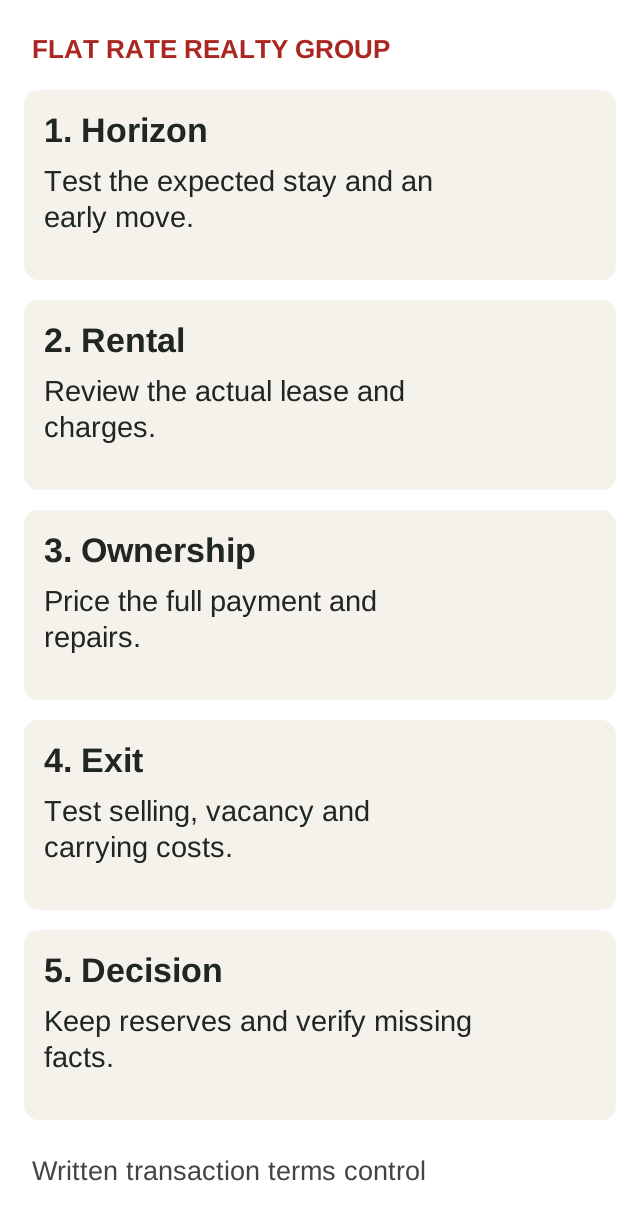
- Write the expected stay and an earlier-move scenario.
- Confirm available on-post, temporary, and community housing options through appropriate sources.
- Obtain a written rental proposal and a property-specific ownership estimate.
- Separate recurring expenses, refundable deposits, upfront costs, and reserves.
- Test repairs, vacancy, and overlapping housing costs without assuming appreciation.
- Review lease questions with legal services and financing questions with the lender.
- Verify the actual route and household destinations for any shortlisted address.
- Document which missing answer would change the decision.
For Fort Carson, begin with the official housing resources for installation assistance and available options. Our off-post comparison guide helps evaluate daily routines after you have identified realistic housing choices. The PCS timeline guide covers coordination when you are ready to organize a purchase.
Questions military households often need to resolve
Is temporary housing wasted money?
Evaluate what it buys your household: arrival flexibility, time to investigate, or a bridge to confirmed possession. Compare the full cost, including storage and another move, with the consequences of rushing an unsuitable commitment. It may be useful in one plan and unnecessary in another. Verify availability and cancellation terms before depending on it.
Does buying protect us from every future housing increase?
No. Even if principal and interest are fixed, other ownership expenses can change. Insurance, taxes, association charges, repairs, and utilities deserve their own review. Ask what the quoted payment fixes and what remains variable. An ownership decision should include the ability to absorb changes rather than assuming the first estimate will remain the entire cost indefinitely.
Can we decide before receiving firm move details?
You can prepare scenarios and investigate options, but label what is uncertain. Avoid making irreversible commitments based on an assumed report date or unverified occupancy arrangement. Share general timing needs with the real estate team and get official military questions answered through the appropriate channels. The strongest next step may be gathering one missing quote or confirming one date.
Compare the cash left after move-in
Make a separate liquidity comparison before choosing. Suppose a fictional household begins with $35,000 in accessible savings. A rental arrangement temporarily ties up $3,000 in a refundable deposit and uses $4,000 for moving and setup. The simplified remaining available cash is $28,000. The deposit still has potential value, but it cannot also pay a repair bill while held by the landlord. Confirm the actual lease and refund conditions.
Suppose the ownership alternative requires $16,000 at closing and another $5,000 for moving and immediate work. The simplified available balance becomes $14,000. These invented figures do not establish whether either reserve is enough. They reveal that two arrangements with manageable monthly costs can leave different levels of flexibility. List other obligations and discuss an appropriate reserve with a qualified financial professional.
Also check when the cash must leave the account. An expense due before reimbursement or before sale proceeds arrive may create a short-term problem even when a later budget looks comfortable. Do not count an expected brokerage credit twice, as both a reduction of closing funds and additional money available afterward. Follow the lender's approved calculation and the final settlement treatment.
End with a written decision record: the preferred arrangement, the assumptions supporting it, the cash that remains, and the events that would prompt reconsideration. If a quote changes or orders arrive, return to those assumptions. This makes the plan easier to update without starting the entire comparison again or feeling committed to a choice made with incomplete information.
General planning information. Written terms, lender approval, and transaction requirements apply. No military or government affiliation or endorsement.