

A Colorado firefighter's home search should work around the real household schedule, a sustainable budget, and carefully documented income. A rebate can be helpful, but it does not replace those decisions. This guide separates our brokerage offer from government programs, explains the questions to raise about overtime, and provides a practical way to compare homes, insurance, maintenance, and closing arrangements without assuming that every firefighter's employment looks the same.
Build a purchase plan around your actual work pattern
Start with the schedule you have, not a generic description of shift work. You may have rotating duty, a different assignment, another job, or household members with their own commitments. Mark the windows when you can tour, take calls, review documents, and attend inspections. Identify who should be contacted if you are unavailable, while leaving financial and contract decisions with the people authorized to make them.
Tell your agent which communication method is useful and when a response is realistically possible. An offer or inspection deadline can fall during a work period, so discuss the process for reviewing time-sensitive information before that happens. This is a coordination plan, not an instruction to sign while distracted or to assume that a colleague can make decisions for you.
Keep your moving day separate from closing and possession. A signed contract establishes obligations, but the specific terms and remaining conditions still matter. Ask when access will be delivered and what needs to be confirmed before arranging movers. If your availability is narrow, price an alternative delivery or temporary housing plan instead of expecting every transaction step to fit one day off.
Separate base pay from overtime in the lender conversation
Make a clear list of income sources and ask the lender what documents are needed for each. Base pay, overtime, bonuses, a second employer, seasonal work, and self-employment can raise different questions. Do not assume that a large recent paycheck will be used unchanged as your qualifying monthly income, or that income from one source will be evaluated like another.
Fannie Mae's current overtime-income guidance recommends a two-year history, while allowing certain shorter histories of at least twelve months with positive factors. It also requires an analysis of the income pattern. That describes loans subject to those rules; it is not a guarantee that your overtime qualifies or an instruction for every mortgage program.
Ask the lender to explain which income is included, what period is reviewed, and whether any job change or decline needs additional documentation. Use the secure upload channel designated by the lender. Keep a simple list of requested items and their status, rather than sending pay records through an informal group message or an initial website inquiry.
Run a personal budget that does not require every extra shift
Your lender's qualification decision and your comfortable household budget serve different purposes. Even if some overtime is accepted, decide how much of it you want to depend on for housing. Consider time off, other commitments, and how much flexibility you would like after the purchase. A home can meet an approval standard and still be a poor fit for the way you want to live.
For a fictional example, suppose a household has $5,000 of monthly take-home base income and sometimes receives an additional $1,000 from overtime. An invented $2,400 housing budget would use 48% of base take-home income, versus 40% of the combined $6,000 month. These percentages are personal cash-flow arithmetic, not lender debt-to-income ratios, underwriting limits, typical firefighter pay, or a recommended payment.
The example shows why it helps to compare both months. Add transportation, food, existing obligations, savings, and irregular expenses. If the budget only works when the extra $1,000 arrives, decide whether that dependence fits your priorities. You might adjust the property range, increase available reserves, or continue preparing. A one-time brokerage credit cannot permanently solve a recurring monthly shortfall.
Understand the firefighter buyer rebate on this site
Firefighters can ask about this site's first-responder buyer offer. Confirm your eligibility and the documentation the Flat Rate Realty Team requires; do not assume that a particular volunteer, retired, seasonal, or other employment status is automatically included. The offer starts with 50% of the buyer-agent commission actually received by the brokerage, subject to the brokerage retaining at least $6,500.
Consider three hypothetical compensation amounts. At $18,000 received, an equal split illustrates a $9,000 rebate and $9,000 retained. At $13,000, each share is $6,500. At $10,000, the illustrated rebate falls to $3,500 so the brokerage retains $6,500. These examples use commission amounts, not assumed commission rates or percentages of the purchase price.
A commission below $6,500 illustrates no rebate and a shortfall to discuss under the written agreement; the formula does not decide who owes the difference. Lender preapproval and a signed buyer agreement are required before our team schedules showings. Review the services, compensation obligation, eligibility, and credit conditions early, then use the full rebate guide to evaluate a specific proposed transaction.
Keep the rebate separate from your reserve and early expenses
A calculated rebate is not cash already in your bank account. Ask the lender and closing professional how any approved benefit can be applied and recorded. Give them the proposed written terms and identify other seller or lender credits. Do not assume the rebate can cover the down payment, required reserves, inspections due earlier, or unrestricted spending after closing.
For loans following Fannie Mae's interested-party contribution guidance, agents and brokers are among interested parties, and the form and use of contributions matter. The lender needs to review the actual combination for your loan. Never arrange an undisclosed side payment to preserve an advertised number if the proposed credit cannot be used as expected.
Make three cash columns: expenses before closing, remaining cash at closing, and money retained afterward. Update them when costs, deposits, price, or compensation change. Ask which amounts already paid will be reflected in the final statement so they are not counted twice. This keeps your emergency cushion separate from money already committed to the purchase.
Do not confuse the offer with a government benefit
Our first-responder rebate is a brokerage compensation arrangement, not an employer benefit, government grant, or special mortgage approval. No fire department or public agency endorses the offer merely because the guide addresses firefighters. Ask the responsible provider about any other assistance you are considering, including eligibility, available funds, repayment, occupancy, and combination rules.
HUD's Good Neighbor Next Door resource identifies firefighters among the occupations covered by that separate program. It involves specified HUD homes in designated revitalization areas and a thirty-six-month residence commitment. It is not a discount that applies to any Colorado listing. Confirm current inventory and the full occupational and property requirements through HUD's authorized process before relying on it.
Do not add the advertised values of different offers together on your budget sheet without review. A program may involve a particular property, financing structure, or ongoing obligation. Compare the actual written proposal, not the largest promotional number. If no suitable program property is available, your ordinary home search and financing comparison still need to stand on their own.
Compare homes for the hours you will actually be there
A home visit on a quiet afternoon may not answer the questions that matter for a household with a different schedule. When practical, investigate the surroundings at relevant times and ask about what remains unknown. Consider room placement, light control, shared walls, parking, delivery access, and the space needed for normal household routines. Avoid treating staging or a quick tour as proof of a quiet sleeping environment.
Map the route to your confirmed work location, not just the nearest station or a city's general center. If assignment changes are possible, discuss which locations you need to evaluate without assuming any future posting. For searches around Colorado Springs, Monument, or another served Colorado area, compare actual addresses and your priorities rather than labeling one neighborhood the best for all firefighters.
Also ask what ownership tasks will need attention while you are working. A larger lot may be appealing but require more maintenance than you want. An HOA may handle some tasks while imposing dues and restrictions you need to review. Storage, exterior access, and garage measurements deserve verification if they affect the decision. Focus on the property as a home, not an extension of the workplace.
Use professional expertise without skipping independent checks
Fire-service experience may help you notice useful questions, but buying your own home still calls for the inspections, insurance review, and specialist advice appropriate to that property. Ask professionals to explain findings and limitations. An observation during a showing is not the same as a complete condition report or a firm repair estimate.
The Colorado State Forest Service wildfire mitigation resources provide homeowner information on risk, home hardening, and defensible space. Use those resources to frame questions about the address and any work needed. Mitigation planning should not be presented as a guarantee of safety, an insurance discount, or coverage availability.
Obtain an address-specific insurance quote early enough to evaluate it. Ask about the premium, deductibles, coverage, exclusions, and any required work or timing conditions. Review taxes, utilities, HOA obligations, and maintenance separately from mortgage principal and interest. The CFPB Loan Estimate explainer is useful for distinguishing the quoted loan payment from other housing costs and the cash required at closing.
| Question | Evidence to request or investigate |
|---|---|
| Does the routine fit? | Actual work destination, route, household schedule, layout, and relevant-time observations. |
| Is the payment sustainable? | Lender estimate plus your own base-income and variable-income budgets. |
| What work is needed? | Inspection findings, specialist evaluation, written estimates, and timing. |
| Can it be insured as planned? | Address-specific quote, coverage terms, deductibles, and requirements. |
| What benefit is usable? | Written rebate calculation and lender and closing confirmation. |
Plan the final walkthrough and first month deliberately
Discuss a final walkthrough that fits the contract and your availability. Ask your agent what needs checking and which agreed items should be documented. If you cannot attend, discuss an appropriate arrangement in advance. Do not assume that the person who can accept a furniture delivery can also verify purchase conditions or make decisions about a contract issue.
Before the move, make a list of utility and service arrangements, access instructions, immediate repair questions, and the records you want available. Identify who is responsible for each item and when it should be complete. Keep deliveries contingent on confirmed access rather than a hopeful closing estimate. A small amount of coordination can make a narrow moving window easier to use.
For the first month, divide projects into immediate needs and optional improvements. If a professional estimate is still outstanding, mark it as unknown instead of assigning a convenient number. Set aside time to learn the home's systems and keep relevant inspection and service records accessible. Owning a home brings a different set of responsibilities from evaluating one during a showing.
Also decide how you will review your budget after the move. Compare the actual recurring costs with the estimates and adjust optional spending if necessary. This is especially useful when the purchase coincides with a job change or a different overtime pattern. The closing benefit is a one-time event; the ongoing household plan needs to remain understandable after the transaction paperwork is filed.
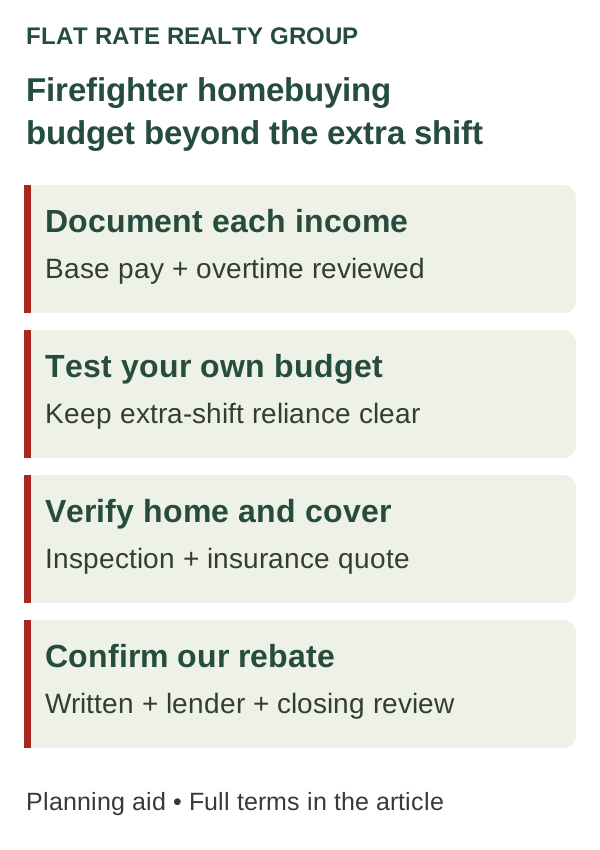
A shift-friendly purchase checklist
- Share realistic showing and communication windows, including a plan for deadline questions.
- Ask the lender to separate base pay, overtime, and other income sources in its explanation.
- Choose a comfortable payment and reserve without assuming every extra shift will be available.
- Obtain preapproval and review the buyer agreement before showings.
- Confirm first-responder eligibility and the rebate calculation in writing.
- Review any separate assistance with its administrator; do not assume universal firefighter grants.
- Arrange inspections and insurance review independently of your own professional familiarity.
- Confirm closing, possession, and delivery separately, with an alternative if your work schedule changes.
Frequently asked questions
Will all my overtime count for a mortgage?
Not automatically. Ask your lender to evaluate the history, documentation, and applicable loan rules. Explain recent changes and keep the lender's qualification calculation separate from the amount of extra work you personally want to rely on for monthly housing.
Is every firefighter eligible for this rebate?
Confirm your particular status with the team and review the written terms. Selecting first responder on the inquiry form starts a conversation; it does not establish eligibility, a commission amount, or a lender-approved credit. Preapproval and a signed buyer agreement are required before showings.
Does the rebate replace a down payment?
Do not assume that. Your lender must confirm the permitted use and documentation of the benefit. Maintain a separate plan for required funds, deposits, and reserves. An illustrative commission split does not approve the use of that money for a specific expense.
Does firefighting experience replace an inspection?
No. Your familiarity may help identify questions, but property-specific inspections and specialist evaluations address the purchase itself. Ask what is covered, what is excluded, and whether further review is needed before making decisions under your contract.
Start with the schedule and numbers that are yours
Use the buyer inquiry form to ask about the first-responder offer and share your Colorado search area, preapproval status, timing, and preferred contact method. Financial documents belong in the secure system your lender designates, not an initial website message. We can help organize the property search while your lender evaluates the financing.
A useful plan leaves you with a sustainable payment, a clear reserve, verified property information, and written rebate terms that everyone understands. Those foundations matter more than the largest projected closing benefit. They give you room to choose a home that supports your household on workdays and days off alike.
Sources and practical resources
Primary sources checked October 20, 2026. Confirm current program availability and your transaction with the responsible lender, program administrator, or professional.
- Fannie Mae's current overtime-income guidance
- Fannie Mae's interested-party contribution guidance
- Good Neighbor Next Door resource
- Colorado State Forest Service wildfire mitigation resources
- CFPB Loan Estimate explainer
General education, not individual financial, legal, or tax advice or loan approval. Eligibility, services, fees, and rebates depend on written terms and applicable lender and closing requirements. Flat Rate Realty Group is independent of VA, the military, CHFA, HUD, employers, and public agencies; links do not imply affiliation or endorsement.