
Colorado FHA Loan Assumptions: What to Verify
By Flat Rate Realty Group · Published October 25, 2026 · Prepared with AI assistance.

An FHA assumption in Colorado deserves a review of the actual loan, not just the advertised interest rate. Confirm who services it, which balance can transfer, how mortgage insurance is handled, whether a partial claim or other obligation must be resolved, and how the buyer will cover the full cash requirement. Build the purchase contract around that verified process.
What this guide helps you verify
An assumption generally involves a buyer taking responsibility for an existing mortgage while purchasing the property. It is different from a new purchase loan for the entire price. HUD's current FHA assumption FAQ states that FHA-insured single-family forward mortgages are assumable. That statement does not establish a particular buyer's approval, identify the current account balance, or eliminate the need to follow the responsible servicer's instructions.
This article focuses on the questions an FHA file can raise. For broader purchase-price gap planning, use our cash-gap guide. For a VA loan, use the VA assumption guide, which addresses a different program. Do not apply VA entitlement or VA funding-fee rules to an FHA transaction simply because both properties are advertised as assumable.
Start an evidence file before comparing rates
Record the listing address, listing identifier, asking price, advertised loan type, stated rate, displayed balance, and the date each figure was obtained. Keep the source beside the number. A listing remark, a search snippet, and a current servicer document are different kinds of evidence. If two sources disagree, preserve both and ask for an explanation rather than silently choosing the more attractive version.
Request confirmation through the seller's authorized process. The servicer may need the account holder's permission before discussing details. Buyers should not ask sellers to share passwords, full account numbers, or unredacted sensitive records through ordinary inquiry forms. Ask the professionals involved which secure channels to use and which limited information is appropriate to exchange at each stage.
At this point, a useful result might be a verified contact and a list of missing documents rather than an immediate offer. Establish whether the seller is willing to pursue an assumption and whether the buyer's available funds appear compatible with the price gap. A property can be worth investigating without the transaction being ready to rely on.
Ask the servicer for the actual application path
Identify the current servicer and the department handling assumptions. Ask how to request an application, what makes a file complete, which documents the buyer must supply, what fees may apply, and how status questions are handled. Confirm whether the person providing the information is describing the actual account rather than a general loan product.
Also ask what the seller must provide and what approval or release documents are expected at the end. The brokerage can help organize the conversation and dates, but it does not approve the transfer or underwrite the buyer. Do not treat a purchase-contract signature as evidence that the servicer has approved the mortgage assumption.
Keep a simple request log with the date, recipient, documents requested, response, and next step. Avoid sending the same sensitive application through multiple unapproved channels in an attempt to accelerate review. A clear, complete submission and a documented follow-up process are more useful than assuming repeated requests establish priority.
Calculate the starting gap, then keep going
Consider a fictional Colorado home priced at $420,000 with a servicer-confirmed first-mortgage balance of $310,000 available for the proposed assumption. The starting price-minus-balance gap is $110,000. That arithmetic does not determine final cash to close. Transaction expenses, deposits, prorations, approved credits, and any other obligations still need separate review.
Suppose the buyer has $125,000 in accessible funds and sets aside an invented $12,000 emergency reserve. That leaves $113,000 for the transaction, only $3,000 above the starting gap. If the file requires an additional $8,000 of buyer-paid closing expenses under the final agreement, the plan is short $5,000 unless another permitted adjustment is made. These figures are invented to illustrate a funding check, not quotes or typical Colorado costs.
Do not solve a shortage by assuming secondary financing will be approved. If additional borrowing is proposed, ask the relevant lender and servicer how it affects underwriting, payment, lien position, documentation, and closing. Compare the combined obligation and cash requirement with a new-loan alternative before deciding that a low first-mortgage rate makes the structure affordable.
Check for partial claims and other separate obligations
HUD's loss-mitigation explanation describes a standalone partial claim as an interest-free subordinate lien used to address past-due amounts. Its published repayment triggers include a sale, assumption, or title transfer. Therefore, ask specifically whether this account has a partial claim or related assistance obligation and obtain transaction-specific instructions from the responsible professionals.
A first-mortgage balance shown online may not reveal every amount that must be addressed. Do not assume that an assistance balance automatically transfers with the first mortgage or that the buyer must always pay it. The account documents, program requirements, title review, and negotiated allocation matter. Ask who obtains the balance and how the obligation will be satisfied or otherwise handled under an approved process.
Extend the fictional example: assume a separate $18,000 obligation is identified. The original $110,000 price-minus-first-mortgage gap has not changed, but there is now another transaction issue to resolve. Adding $18,000 to the buyer's budget without checking the seller's proceeds and the agreed treatment could double-count or misallocate the amount. Have the closing professional reconcile the full flow of funds.
Ask how FHA mortgage insurance affects the payment
Do not compare an assumed note's principal-and-interest figure with a new loan's all-in payment. Ask for an itemized estimate showing principal, interest, any FHA mortgage insurance, property taxes, property insurance, association charges, and other recurring obligations. Confirm what is included in the servicer payment and what is paid separately.
HUD's mortgage-insurance resources are a starting point for understanding that the applicable loan details matter. Ask the servicer to explain the actual premium, the relevant loan history, and whether and when it can end for this mortgage. Do not assume that paying a large equity gap automatically cancels FHA mortgage insurance or that conventional private-mortgage-insurance rules apply.
In an invented comparison, principal and interest might be $1,450, mortgage insurance $140, taxes and property insurance $430, and association dues $180. The simplified total is $2,200 monthly. Omitting the latter three categories would understate the illustrated total by $750. None of these amounts is a current rate or premium quotation; obtain figures for the actual property and file.
Compare two financing paths on the same basis
Create two columns: the proposed assumption and a new purchase loan. Use the same negotiated property price and possession needs, but allow the funding structure to differ. Record cash required, monthly obligations, remaining term, upfront charges, approval dependencies, and money left in reserve. A lower rate does not automatically compensate for a cash requirement the buyer cannot meet.
If the assumed loan has a shorter remaining term, ask the lender to explain how that changes principal repayment and the monthly comparison. If another loan is needed to bridge the gap, include its payment and charges. Do not label the combined structure with only the assumed first mortgage's rate. The buyer needs to understand every obligation being proposed.
Keep property condition in both columns. An assumption is a financing path, not a substitute for evaluating the roof, systems, insurance, association documents, or title. Ask what inspections and other investigations are appropriate and what the contract allows. A loan that appears favorable can still be attached to a property that does not fit the household's needs or reserves.
Coordinate a realistic contract calendar
Ask the servicer for its current process and distinguish an estimated review period from a guaranteed closing date. The calendar should account for application completion, responses to additional requests, property investigations, gap funding, approval conditions, document preparation, and possession. Do not copy a VA processing timetable into an FHA agreement.
Have the broker explain the actual financing and other deadlines in the completed Colorado contract. Identify what happens if approval is not received on the expected date and who must act under the agreement. If the household has a fixed reporting date or another home to sell, put the separate housing fallback on the calendar too.
A useful checkpoint asks whether the application is complete, which conditions remain, and what evidence supports the next milestone. “Still working on it” does not provide enough information for a moving reservation. Confirm what is known before making a nonrefundable commitment, and discuss any proposed contractual change with the appropriate professionals.
Review any brokerage rebate separately
On this site, Flat Rate Realty Group's offer is 50% of commission actually received, reduced as needed so the brokerage retains at least $6,500. Lender preapproval and a signed buyer agreement are required before showings. Eligibility, written terms, lender requirements, and closing requirements apply. It is a brokerage offer, not an FHA benefit or HUD endorsement.
For an invented $12,000 received commission, a preliminary $5,500 rebate preserves the $6,500 minimum. That is not a promise of funds available for the equity gap. Ask the lender, servicer, and settlement professionals which uses are permitted and how the credit would be documented. Read our rebate-at-closing guide before including it in the funding plan.
Compare the same household cash budget
One way to make the financing comparison more useful is to hold the household's available cash constant. Suppose a fictional buyer has $140,000 available after preserving an emergency reserve. An assumption proposal requires $118,000 of verified closing funds, while a new-loan proposal requires $55,000. The difference is $63,000 of cash committed to the transaction. That does not prove either choice is preferable; it identifies the liquidity tradeoff that a rate-only comparison misses.
Ask what the remaining cash would need to do in each scenario. If the home requires work, moving expenses are still outstanding, or income is changing, the larger remaining balance may matter. Alternatively, a household may prefer the obligation and remaining term of a fully reviewed assumption. Compare the actual monthly totals, financing charges, principal repayment illustrations, and available reserves together. Do not assume that using less cash at closing is free or that using more cash automatically creates a better outcome.
Ask the lender to identify which comparison figures are quotations and which are placeholders. A new-loan rate that has not been locked can change; a displayed assumed balance may also be dated. Write the dates beside the inputs and rerun the comparison when a material figure changes. Avoid combining the best rate from one proposal with the lowest closing costs from another proposal and presenting that combination as available.
Resolve conflicting documents before funding
Use a reconciliation list when the approval, contract, and closing figures do not match. Identify the line, the two amounts, the source dates, and the professional responsible for explaining the difference. A changed principal balance may simply reflect scheduled payments, while an additional amount could represent an expense or obligation not included in the original worksheet. Do not assume a discrepancy is either harmless or an error until it is explained.
Before closing, ask the servicer and settlement professionals how the approved transfer will appear in their records, where the buyer's payment instructions will come from, and what final documents each party should retain. The seller should obtain the applicable liability documentation rather than relying on a verbal statement that the home has changed hands. Keep copies of the signed purchase documents, assumption approval, settlement records, and any separate obligation-resolution documents through the professionals' secure process.
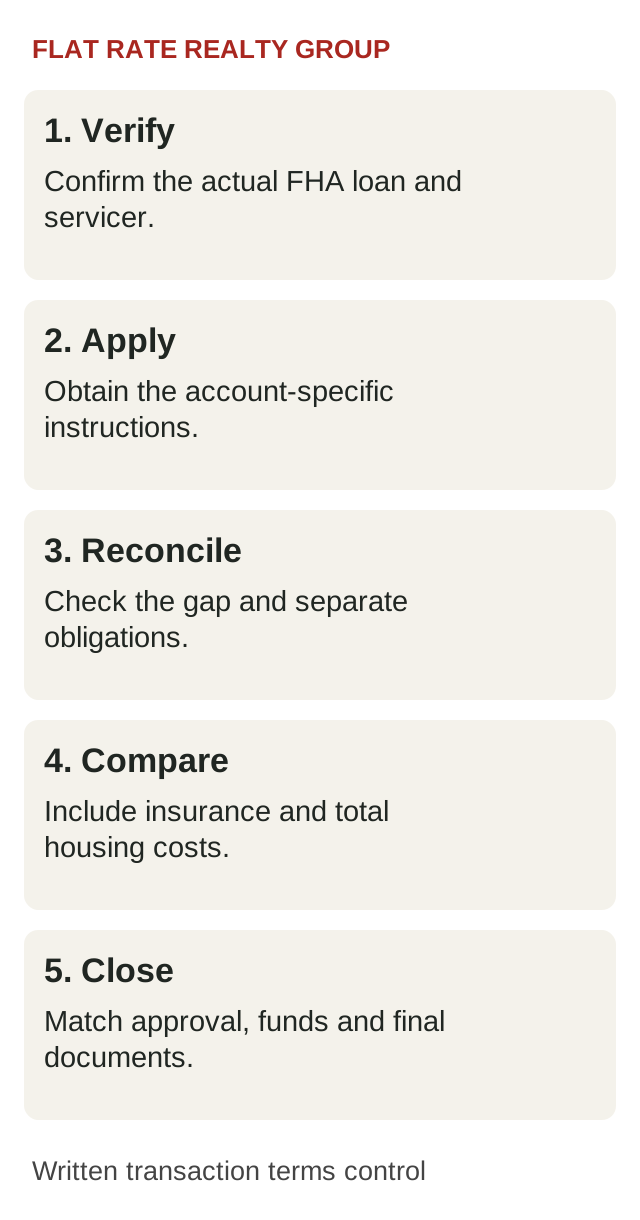
An FHA assumption verification checklist
- Confirm the loan type, current servicer, rate, balance date, and remaining term.
- Obtain the account-specific assumption instructions and required buyer documents.
- Identify mortgage insurance and all recurring housing costs.
- Ask about partial claims, subordinate obligations, and title issues.
- Reconcile the equity gap, closing expenses, deposits, credits, and reserves.
- Obtain approval for any proposed additional financing.
- Match the purchase calendar to the actual process and a housing fallback.
- Review final approval, liability treatment, closing documents, and payment instructions.
Questions before relying on an FHA listing
Does an online “verified” badge confirm my approval?
No. A marketing platform's label does not establish your credit approval, final balance, cash requirement, or eligibility. Ask what the label refers to and obtain the actual account and transaction documentation. The broker and servicer still need to verify the proposed assumption and its conditions.
Is the advertised down payment the same as cash to close?
Not necessarily. A displayed amount may be only the asking price minus an estimated balance. Closing charges, other obligations, credits, deposits, and adjustments can change the final requirement. Label the initial figure as a starting estimate and request a complete reconciliation before committing funds.
What if the balance exceeds the asking price?
Do not describe a negative price-minus-balance figure as free equity or a zero-cash purchase. The mismatch needs an approved transaction-specific resolution. Ask the seller, servicer, and closing professionals what must be paid, by whom, and whether the proposed structure is feasible. A website calculator cannot resolve that issue.
General planning information. Eligibility, written agreements, lender approval, and transaction requirements apply. No government affiliation or endorsement.